
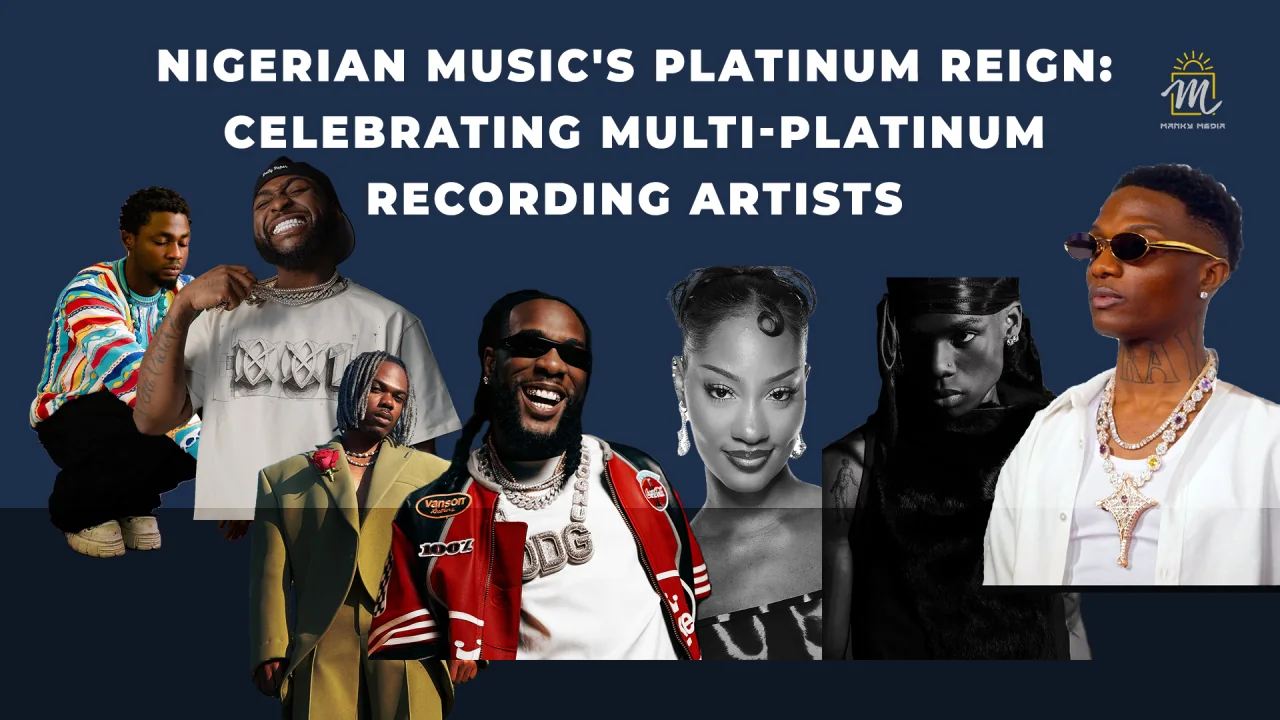
Nigerian music is no longer asking for a seat at the global table. It is already shaping the conversation.
Over the last decade, Afrobeats and Nigerian pop have moved from regional dominance into global recognition, with Nigerian artists earning major certifications across markets such as the United States, the United Kingdom, France, Canada, and Nigeria’s own TurnTable certification system.
These plaques are more than shiny career milestones. They are proof of audience demand, streaming power, cultural export, fan loyalty, and the commercial strength of Nigerian music in the global marketplace.
At Manky Media, we believe culture should be discussed with both passion and accuracy. So this piece is not an attempt to rank every Nigerian artist by every plaque they have ever received. Instead, it is a snapshot of key artists whose certifications help tell the story of Nigerian music’s platinum era.
Why Certifications Matter
In the music industry, certifications help measure how widely a song or album has performed in a specific market. In the United States, for example, RIAA certifications are tied to sales and streaming-equivalent units. In France, SNEP tracks certifications for the French market. In Canada, Music Canada handles certifications. In Nigeria, TurnTable Charts has become an important local reference point for certifying commercial impact.
These systems differ by country, but the cultural meaning is similar: people are listening, replaying, buying, sharing, and carrying the music into their everyday lives.
For Nigerian artists, these certifications signal something bigger than individual success. They show how far the sound has travelled and how strongly global audiences are responding.
Wizkid: The Global Trailblazer
Wizkid remains one of the central figures in Nigerian music’s international rise. His catalogue and collaborations helped open doors that many African artists now walk through more confidently.
His contribution to Drake’s “One Dance,” alongside Kyla, remains one of the most globally significant Nigerian-linked records. Beyond that, “Essence” featuring Tems became a major cultural bridge for Afrobeats, earning multi-platinum recognition in the United States and becoming one of the defining African records of its era.
What makes Wizkid’s certification story important is not only the numbers. It is the role he played in normalizing Nigerian music at the highest level of global pop conversation.
CKay: The Viral Hit That Became a Commercial Giant
CKay’s “Love Nwantiti” is one of the clearest examples of how internet virality can turn into serious commercial impact when the song itself has emotional reach.
The record moved from TikTok momentum into streaming dominance, international chart presence, and major certification success. Its U.S. performance placed CKay among the strongest Nigerian certification stories of the streaming era.
“Love Nwantiti” proved that Nigerian records could travel through mood, melody, and digital culture without needing traditional gatekeepers to understand them first.
Rema: The New-Generation Record Breaker
Rema’s “Calm Down” became one of the biggest Afrobeats records of all time, especially after its remix with Selena Gomez expanded the song’s reach across global pop audiences.
The song’s success across the United States, France, and other markets showed how Nigerian music could sit comfortably inside global pop while still carrying its own rhythmic identity.
Rema’s rise is especially important because it reflects the new generation of Nigerian artists who are not simply crossing over; they are building from an already global starting point.
Tems: A Singular Voice With Global Weight
Tems has built one of the most distinct international profiles in modern Nigerian music. Her voice, writing style, and emotional texture have made her stand out across solo records and major collaborations.
From “Essence” with Wizkid to “WAIT FOR U” with Future and Drake, Tems’ certification story shows the power of a unique voice meeting the right global moments.
Her success also matters because it widens the picture of Nigerian music’s global rise. It is not only about party records or dance anthems. It is also about tone, feeling, songwriting, mood, and identity.
Burna Boy: The African Giant’s Certification Footprint
Burna Boy’s certification journey reflects both global reach and local dominance. His music has earned recognition across international markets, while his Nigerian certification record shows the scale of his commercial power at home.
TurnTable’s recognition of Love, Damini and “Sungba Remix” places Burna Boy in a unique position within Nigeria’s recorded music certification conversation.
Burna’s success is also a reminder that Afrobeats’ global movement is not only a digital trend. It is supported by albums, tours, fan communities, brand identity, and a consistent international performance culture.
Davido: Consistency Across Eras
Davido’s certification story is built on consistency. From early global-facing records like “Fall” to later hits and collaborations, he has shown how Nigerian pop can travel across time, markets, and audience types.
“Fall” remains one of the important records in Afrobeats’ international expansion, helping prove that Nigerian songs could build meaningful life outside their first release window.
Davido’s strength has always been his ability to connect mass appeal with strong choruses, accessible emotion, and a brand presence that keeps him visible across different phases of the industry.
Omah Lay and the Next Wave
Omah Lay represents another important side of Nigerian music’s global movement: mood-driven songwriting, intimate melodies, and emotional vulnerability.
While some of the biggest certification conversations often focus on the more commercially dominant records, artists like Omah Lay show how the global audience for Nigerian music is expanding beyond one sound or one formula.
The next phase of Nigerian music’s platinum reign will likely include more artists whose impact is built not only on dancefloor dominance, but also on personal storytelling, emotional resonance, and genre-fluid experimentation.
A Note on Accuracy
Music certifications change over time as songs continue to stream, sell, and cross new thresholds. This article should be treated as a culture snapshot, not a final historical ranking.
Before using any certification claim for press, pitch decks, legal documentation, or official artist profiles, always verify the latest status directly from the relevant certification body.
The Bigger Story: Afrobeats as Commercial Power
What these achievements show is simple: Nigerian music is not only culturally influential; it is commercially powerful.
The global rise of Afrobeats has created new opportunities for artists, producers, songwriters, managers, video directors, designers, marketers, publishers, media houses, and creative agencies. Every certification points back to an ecosystem of people building the sound, visuals, campaigns, stories, and infrastructure around the music.
This matters for companies like Manky Media because culture does not move by sound alone. It moves through images, narratives, rollouts, documentation, branding, community, and consistent media execution.
When a Nigerian song goes platinum in another country, it is not just a win for the artist. It is a signal that the wider creative ecosystem has global value.
Final Thought
Nigerian music’s platinum reign is not an accident.
It is the result of years of experimentation, persistence, diaspora connection, local fan support, digital platforms, visual storytelling, and artists refusing to shrink their sound for global acceptance.
From Lagos to London, Paris, Toronto, New York, Johannesburg, and beyond, Nigerian music has become a global language.
And as more artists cross new commercial milestones, one thing becomes clearer: Afrobeats is not just having a moment. It is building history.
Source Notes
Certification details should always be checked directly with the relevant certification bodies because figures can change over time.
Useful references include: RIAA Gold & Platinum, SNEP Certifications, Music Canada Gold/Platinum, BPI Awards, and TurnTable Charts.